

LangExtract——大模型文本提炼工具
概述
什么是LangExtract
LangExtract是一个Python库,旨在利用大型语言模型(LLMs)从非结构化文本文档中提取结构化信息。该库能够处理临床笔记、文学文本或报告等各类材料,识别并组织关键细节,同时确保提取数据与源文本位置之间保持精确映射。
核心能力
- 标注来源:将每个提取映射到源文本中的精确字符位置。
- 结构化输出:根据少量样本规范生成结构化输出模式。
- 长文档处理:通过分块和并行处理机制,高效处理大量文本。
- 交互式可视化:生成 HTML 文件,以便在原始文本上下文中审查提取内容。
- 多供应商支持:兼容云端LLM(如Gemini、OpenAI)和本地部署模型(如Ollama)。
- 领域适应性:可使用示例配置任何提取任务,以适应特定领域需求。
实践
安装
LangExtract 可从 PyPI 安装,也可以从源代码构建。该库需要 Python 3.10 及以上版本,并为特定提供程序提供可选的依赖项。
标准安装
pip install langextract开发安装
git clone https://github.com/google/langextract.git
cd langextract
pip install -e ".[dev]"
基本工作流
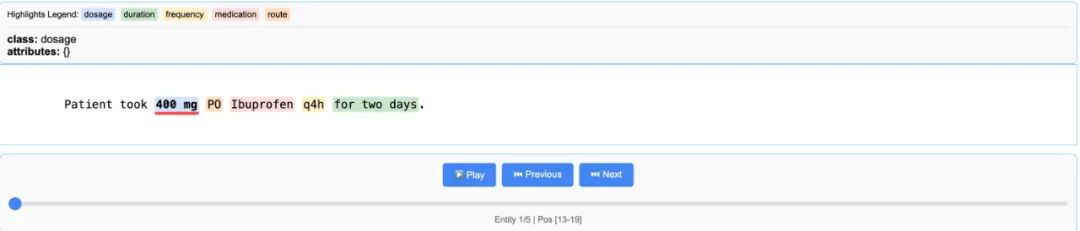
LangExtract的工作流程主要包括以下步骤:
-
定义输入样本:创建提示词(
prompt_description)和示例(examples)来指导模型。 -
调用
lx.extract()函数处理输入文本。内部处理流程如下:
- 输入处理: 如果
fetch_urls=True且输入是 URL, 会自动下载文本。 - 创建提示模板: 使用
PromptTemplateStructured组织提示词和示例。 - 模型配置: 根据参数优先级创建语言模型(优先级:
model>config>model_id)。 - 文本处理: 通过
Annotator协调文本分块、并行处理和结果解析。 - 结果对齐: 使用
Resolver将提取结果对齐到源文本位置。
- 输入处理: 如果
-
可视化结果:保存结果并生成交互式 HTML 可视化。
返回的
AnnotatedDocument包含:- 原始文本和
document_id。 Extraction对象列表,每个包含char_interval位置信息。- 每个提取的
AlignmentStatus表示匹配质量。
- 原始文本和
对于长文档,可以使用 URL 直接处理并启用并行处理和多次提取来提高性能和准确性。系统支持多种模型提供商(Gemini、OpenAI、Ollama 等),通过工厂模式自动选择合适的提供商。
调用Qwen示例
import langextract as lx
from langextract import factory
from langextract.providers.openai import OpenAILanguageModel

# Text with a medication mention
input_text = "Patient took 400 mg PO Ibuprofen q4h for two days."

# Define extraction prompt
prompt_description = "Extract medication information including medication name, dosage, route, frequency, and duration in the order they appear in the text."

# Define example data with entities in order of appearance
examples = [    lx.data.ExampleData(        text="Patient was given 250 mg IV Cefazolin TID for one week.",        extractions=[            lx.data.Extraction(extraction_class="dosage", extraction_text="250 mg"),            lx.data.Extraction(extraction_class="route", extraction_text="IV"),            lx.data.Extraction(extraction_class="medication", extraction_text="Cefazolin"),            lx.data.Extraction(extraction_class="frequency", extraction_text="TID"),  # TID = three times a day
            lx.data.Extraction(extraction_class="duration", extraction_text="for one week")
        ]
    )]

result = lx.extract(    text_or_documents=input_text,    prompt_description=prompt_description,    examples=examples,    fence_output=True,    use_schema_constraints=False,    model = OpenAILanguageModel(        model_id='qwen-plus',        base_url='',        api_key='',        provider_kwargs={            'connect_timeout': 60,  # 允许 60 秒完成 SSL 握手
            'timeout': 120          # 保持 120 秒的整体请求超时
        }
    ))

# Display entities with positions
print(f"Input: {input_text}
")
print("Extracted entities:")
for entity in result.extractions:    position_info = ""    if entity.char_interval:        start, end = entity.char_interval.start_pos, entity.char_interval.end_pos        position_info = f" (pos: {start}-{end})"    print(f"• {entity.extraction_class.capitalize()}: {entity.extraction_text}{position_info}")

# Save and visualize the results
lx.io.save_annotated_documents([result], output_name="medical_ner_extraction.jsonl", output_dir=".")

# Generate the interactive visualization
html_content = lx.visualize("medical_ner_extraction.jsonl")
with open("medical_ner_visualization.html", "w") as f:    if hasattr(html_content, 'data'):        f.write(html_content.data)  # For Jupyter/Colab
    else:        f.write(html_content)
print("Interactive visualization saved to medical_ner_visualization.html")
这段代码的核心目标是:使用 LangExtract 库对接大语言模型(Qwen),从医疗文本中自动提取结构化的药物信息(剂量、途径、名称等),并通过打印、文件保存、HTML 可视化等方式展示结果。该流程适用于医疗文本分析、药物信息抽取等场景。
界面展示
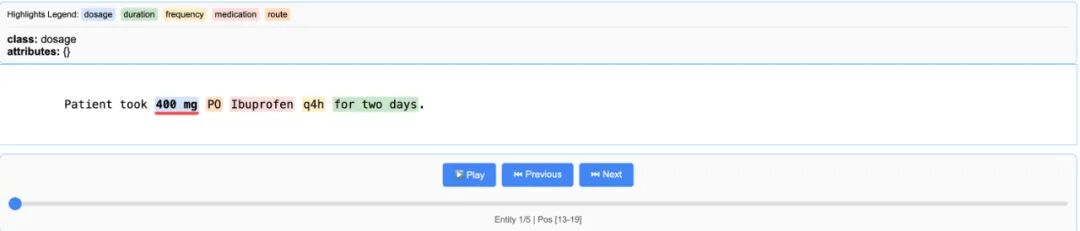
在生成的HTML文件中,需要增加UTF-8字符集声明以避免乱码问题:
<!DOCTYPE html><html><head> <meta charset="UTF-8"> <title>医疗实体提取可视化</title> <style> <!-- 原有CSS样式保持不变 --> </style></head><body> <!-- 原有HTML内容保持不变 --> <div class="lx-animated-wrapper lx-gif-optimized"> <!-- ... 原有内容 ... --> </div> <script> <!-- 原有JavaScript代码保持不变 --> </script></body></html>此外,注意到该库最初对中文支持不足。
增加中文分词支持
为了支持中文,需要进入 LangExtract 的 tokenizer 分词部分进行修改。更新后的匹配模式如下:
# ✅ Updated to support Chinese characters (CJK Unified Ideographs, Extension A, Compatibility Ideographs)
#    and other Unicode languages
_LETTERS_PATTERN = (
    r"[A-Za-zu4e00-u9fffu3400-u4dbfuf900-ufaff]+")"""匹配中文、英文的连续字母(包含CJK基本区、扩展A区、兼容区)"""
_DIGITS_PATTERN = (
    r"[0-9uff10-uff19]+")"""匹配阿拉伯数字与全角数字"""
_SYMBOLS_PATTERN = (
    r"[^A-Za-z0-9u4e00-u9fffu3400-u4dbfuf900-ufaffs]+")"""匹配除中文、英文、数字和空格外的符号(含全角符号)"""
_END_OF_SENTENCE_PATTERN = re.compile(r"[.?!。?!]$")"""匹配句末符号(含中英文标点)"""
_SLASH_ABBREV_PATTERN = (
    r"[A-Za-z0-9u4e00-u9fffu3400-u4dbfuf900-ufaff]+"
    r"(?:/[A-Za-z0-9u4e00-u9fffu3400-u4dbfuf900-ufaff]+)+")"""匹配类似 '中/英/混合' 这种带斜杠的缩写或组合词"""
_TOKEN_PATTERN = re.compile(
    rf"{_SLASH_ABBREV_PATTERN}|{_LETTERS_PATTERN}|{_DIGITS_PATTERN}|{_SYMBOLS_PATTERN}")"""通用token匹配模式:支持中文、英文、数字、符号"""
_WORD_PATTERN = re.compile(
    rf"(?:{_LETTERS_PATTERN}|{_DIGITS_PATTERN})Z")"""匹配完整词语(字母或数字结尾)"""
通过以上修改即可实现中文支持。
PDF文档处理支持
LangExtract 目前主要支持处理原始文本字符串。在实际工作流程中,源文件通常以 PDF、DOCX 或 PPTX 格式存在,这要求用户进行以下手动操作:
- 手动将文件转换为纯文本(此过程可能丢失原始文档的布局和出处信息)。
- 将纯文本输入到 LangExtract 中进行处理。
- 手动将提取内容映射回原始文档以进行验证。
若能实现单步流程,将极大简化 LangExtract 的采用和使用。
建议的解决方案
建议将 Docling 库作为 LangExtract 的可选前端进行集成:
- Docling 能够将多种文档格式(如 PDF)转换为统一的 DoclingDocument 对象。
- 它在转换过程中能保留原始文档的来源信息(包括页面、边界框和阅读顺序)。
- 将从 Docling 提取的文本块按照当前 LangExtract 的方式输入。
- 通过起源元数据,将 LangExtract 的提取结果映射回原始文档。
此集成将是可选的(通过pip install langextract[docling]安装),从而确保核心包保持轻量级,无额外依赖。
概念验证
以下代码展示了一个概念验证示例,目前尚未集成到 LangExtract 库中:
import langextract as lx
import textwrap
from pdf_extract import extract_with_file_support
# 1. Define the prompt and extraction rules
prompt = textwrap.dedent(""" Extract characters, emotions, and relationships in order of appearance.
Use exact text for extractions. Do not paraphrase or overlap entities.
Provide meaningful attributes for each entity to add context.""")
# 2. Provide a high-quality example to guide the model
examples = [ lx.data.ExampleData( text="ROMEO. But soft! What light through yonder window breaks? It is the east, and Juliet is the sun.", extractions=[ lx.data.Extraction( extraction_class="character", extraction_text="ROMEO", attributes={"emotional_state": "wonder"} ), lx.data.Extraction( extraction_class="emotion", extraction_text="But soft!", attributes={"feeling": "gentle awe"} ), lx.data.Extraction( extraction_class="relationship", extraction_text="Juliet is the sun", attributes={"type": "metaphor"} ), ]
)]
source = "<sample pdf file>.pdf"
result = extract_with_file_support( source=source, prompt_description=prompt, examples=examples, model_id="gemini-2.5-flash",)
# result.extractions[0].extraction_text
# result.extractions[0].provenance